Organization
The merchant tenant. Every record in the system belongs to exactly one, and queries are scoped to it rather than filtered after the fact.
LaurelID Console
Create devices, activate them once, bind them to a location, and govern what they are allowed to do — from a control plane designed without patron identity.
01 · Provisioning
A device record is created before any hardware is touched. Activation consumes a single-use code and issues an encrypted device credential that never leaves the device’s hardware-backed keystore. A code that has been used is spent — there is no second activation from the same code.
02 · Structure
Location is the canonical operational model. Reporting rolls up to it, permissions scope to it, and policy is evaluated against it — which is why a verifier cannot be reassigned in place.
The merchant tenant. Every record in the system belongs to exactly one, and queries are scoped to it rather than filtered after the fact.
A physical site. Verifiers, aggregate counts, and reporting all hang off it. The address stored here is the venue’s, never a patron’s.
Owners, operators, installers, and viewers see different surfaces. Report suppression applies to every role, including the highest one.
03 · What the Console shows
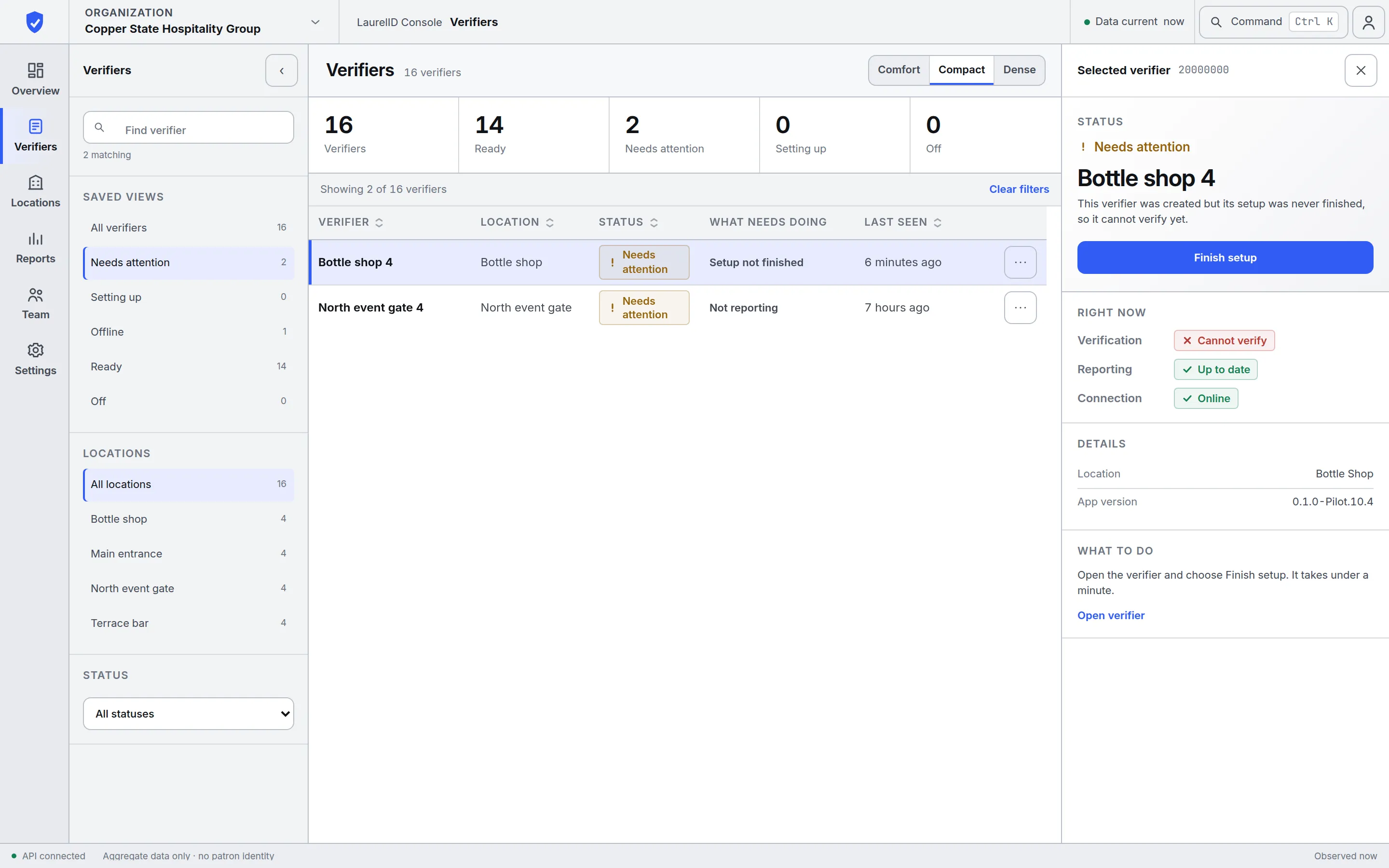
Ready, Setting up, Needs attention, Off. A verifier that needs attention says why in one sentence and names the one thing to do about it.
Three separate answers for every verifier. A verifier that lost its network keeps its last confirmed “verifying” answer, with the time it was confirmed, instead of looking broken.
Versions, configuration, trust freshness and the complete diagnostic record stay one disclosure away for support, and out of the way for everyone else.
04 · Auditability
Lifecycle actions, policy changes, and fleet-health transitions are recorded as typed operational events. Their metadata is constrained by a schema keyed to each event type, so there is no free-text field where a name could land “just this once.”
Pilot scope includes Console access, deployment support, and the same reporting-suppression rules described in the trust center.